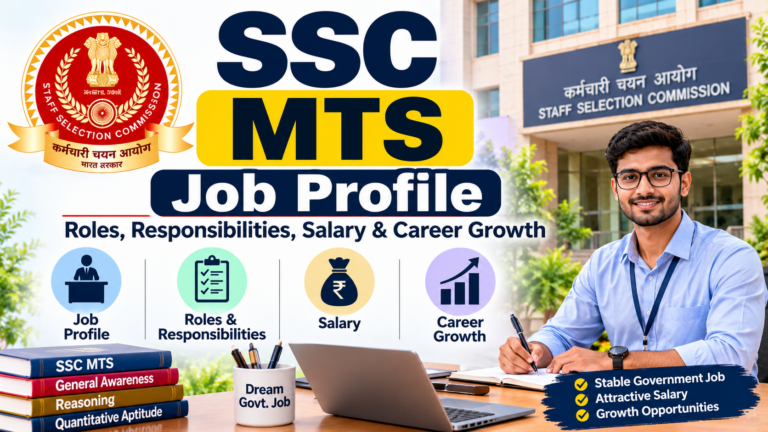
What the job actually looks like day to day, how much you can earn, and what opportunities you have to progress in Central Government service.
Clear the SSC Multi-Tasking Staff (MTS) examination, and you can begin your career in a Central Government ministry, department or office after completing Class 10. For candidates seeking an entry-level government job, it offers an opportunity to enter public service with a structured pay scale, applicable allowances and the possibility of departmental promotion.
The job is not limited to one particular task. Depending on the office, you may maintain records, move files, assist with routine administrative work, organise documents, deliver official papers or perform other duties assigned by the department. The examination also recruits Havaldars for specified positions in the Central Board of Indirect Taxes and Customs (CBIC) and the Central Bureau of Narcotics (CBN), which have distinct responsibilities.
One of the main attractions is the opportunity to enter Central Government service with a starting basic pay of ₹18,000 under Pay Level 1. Allowances and future increments contribute to the overall salary, while departmental promotion rules provide opportunities for career advancement. This guide covers the roles, responsibilities, salary and career growth.
Key Takeaways
SSC MTS recruits candidates for Multi-Tasking Staff positions in Central Government ministries, departments and offices, while the associated recruitment examination also covers specified Havaldar posts. MTS duties include routine office assistance, record handling, file movement and other assigned tasks. Both MTS and Havaldar posts carry Pay Level 1 under the applicable pay matrix, with a starting basic pay of ₹18,000. Admissible allowances increase the overall salary. Promotion opportunities depend on departmental rules, vacancies, seniority and eligibility.
Roles and Responsibilities
Office Assistance: Supports the day-to-day functioning of government offices by performing routine administrative tasks.
File and Record Management: Moves files, organises documents, maintains records and assists in retrieving official information.
Office Maintenance: May assist with keeping official spaces organised and ensuring that routine office arrangements function smoothly.
Document Delivery: May carry official papers, letters and files between sections or offices, according to assigned duties.
Other Assigned Tasks: May include photocopying, scanning, basic logistical assistance and other non-technical work permitted under the post’s duties.
The exact responsibilities depend on the department, office and official duty allocation.
What Does a Havaldar Do?
Havaldars recruited through SSC MTS and Havaldar examinations are appointed to specified posts under CBIC and CBN. Their duties may involve office support, security-related responsibilities, assistance with departmental operations and other functions assigned by the relevant authority.
Unlike the regular MTS post, Havaldar recruitment includes prescribed Physical Efficiency Test (PET) and Physical Standard Test (PST) requirements.
SSC MTS Salary Structure
SSC MTS and Havaldar posts fall under Pay Level 1 of the applicable Seventh Central Pay Commission pay matrix.
- Starting Basic Pay: ₹18,000 per month.
- Pay Scale: ₹18,000–₹56,900.
- Dearness Allowance (DA): Provided according to the applicable government rate.
- House Rent Allowance (HRA): Depends on the applicable rules and posting location.
- Transport Allowance (TA): Payable according to the relevant entitlement and conditions.
The gross salary includes basic pay and applicable allowances, while the in-hand salary is affected by deductions and other applicable rules.
3. Promotion and Career Growth
SSC MTS offers opportunities to progress into higher departmental positions, although the promotion structure differs between departments.
Employees may become eligible for higher posts through departmental promotion channels, subject to service rules, vacancies, seniority, eligibility and departmental examinations where applicable.
Promotion is not automatic after a fixed period. The actual time required depends on the department and its recruitment and promotion rules.
Employees who acquire additional qualifications may also consider other government examinations for which they are eligible.
Work-Life Balance
Many MTS positions involve routine office-support duties, but the physical nature and workload of the job depend on the department and assignment.
Some roles may require frequent movement within office premises, handling files or assisting with logistical tasks. Others may involve different operational responsibilities.
Candidates should therefore understand the specific duties of the allotted post instead of assuming that every MTS position involves identical work or working hours.